
The Short Answer
Key points
- Cold radiators, banging and water at the base are the main warning signs.
- Failed circulators, zone valves and leaking fittings are usually repairs.
- A cracked vessel or an old boiler with repeated failures may be better replaced.
- A new boiler must be sized to the heat loss of the house.
- Schedule service in the fall, not during the first cold snap.
Signs a Boiler Is Struggling
Cold radiators
Air in the lines, a failed circulator or a closed zone valve.
Banging or kettling
Air, low water or scale on the heat exchanger.
Water at the base
A leaking fitting, relief valve or the vessel itself.
Rising bills
The boiler is working harder for the same heat.
Some of these are fixes you can try, like bleeding a radiator. Others, like water at the base, need a plumber before the leak gets worse.
Repair or Replace?
| Situation | Usual answer |
|---|---|
| Failed circulator or zone valve | Repair |
| Leaking fitting or relief valve | Repair |
| Cracked heat exchanger or vessel leak | Replace |
| Boiler more than about 20 years old with repeated repairs | Consider replacing |
| Heating bills climbing and parts hard to find | Compare repair with replacement |
Age alone is not a reason. A well-kept boiler can run for decades. The question is the cost of repair compared with the age, the efficiency and how likely the next failure is.
What Installation Involves
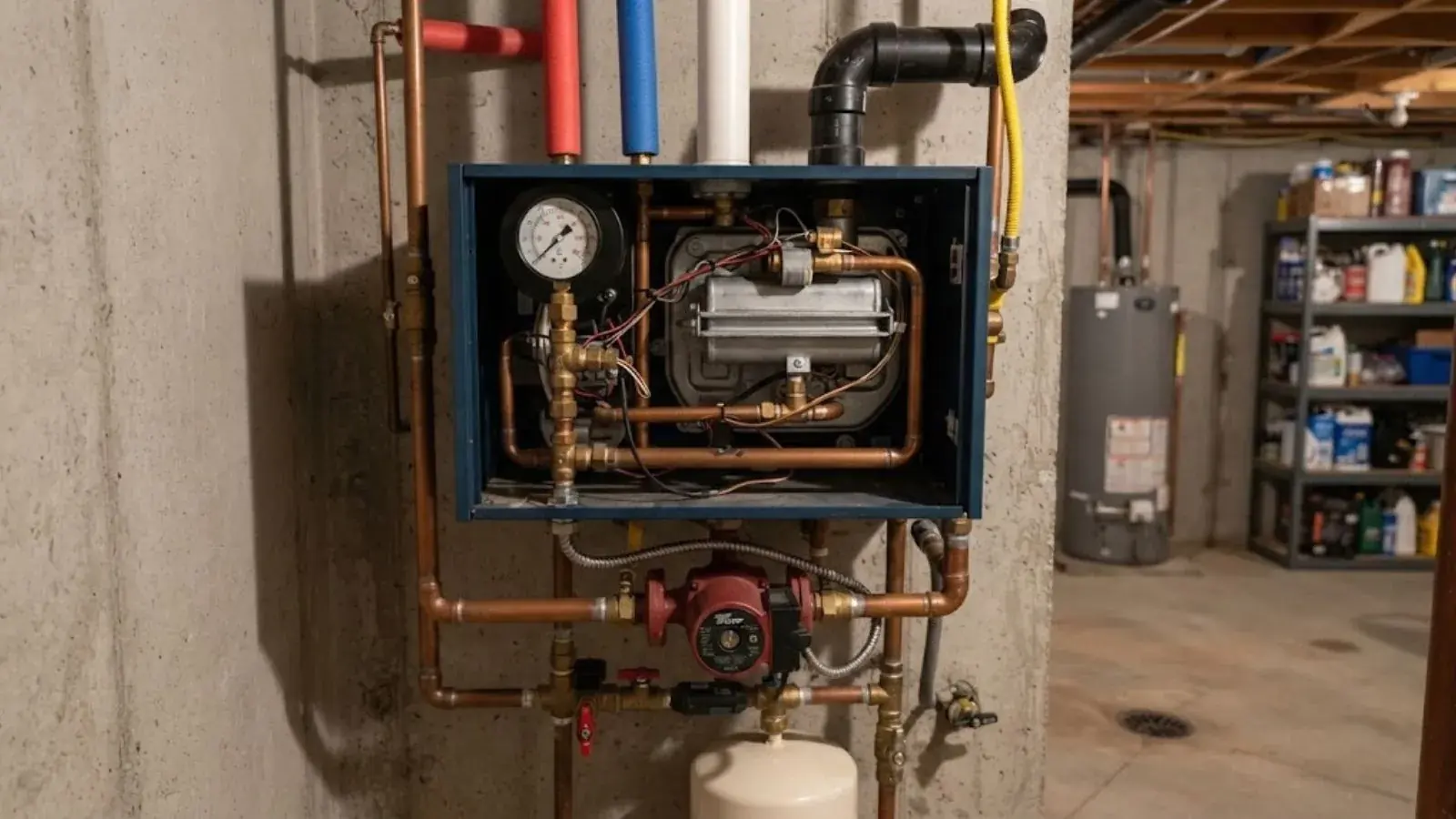
A boiler install connects the supply and return piping, a gas or oil line, a vent and a drain. It includes an expansion tank, an air separator, a relief valve and a pressure gauge. The new boiler has to be sized to the heat loss of the house, not to the old boiler by default.
Fuel, venting and electrical work have their own rules, and heating contractors often do the burner side. We tell you honestly which parts we do and which need a specialist.
Preparing for Winter
- Bleed radiators and check the pressure gauge
- Look for stains or white crust at joints
- Check that the relief valve line is clear
- Replace worn thermostats if rooms are uneven
- Schedule a service visit in the fall
A visit in October is easier than one in January. If the boiler fails in winter, call the 24/7 line, and we try to book the next available visit.
Sizing and Efficiency
A boiler that is too large cycles on and off often, which wastes fuel and wears parts. A proper heat loss calculation sizes the boiler to the house, and a modulating condensing unit can raise efficiency further when the system is designed for lower water temperatures.
Ask any installer how the boiler was sized and not only what brand it is.
Warranty and Records
Keep the installation date, the model and serial number and any service records. Manufacturers often require annual service to keep a warranty valid.
A short service log also helps us diagnose a problem quickly when the heat goes out.
Choosing Between Radiators and Baseboards Upgrades
If your house uses cast iron radiators, a new boiler can work with them at the right water temperature. Baseboard systems use less water volume and respond faster. Mixed systems need careful zoning.
A heating contractor can tell you whether upgrades to piping or controls make sense with a new boiler. We handle the piping and the water side, and we say so when a specialist is better.
Controls matter. A good thermostat setup and zone valves can cut fuel use as much as the boiler itself.
What Winter Emergencies Look Like
The classic emergency is a house with no heat in a freeze. If you have to leave the boiler off, open cabinet doors to let warm air reach pipes, let a faucet drip and keep the house as warm as you can with space heaters used safely.
If the cause is a leak, shut off the water feed to the boiler. Call the 24/7 line and describe what you see.
Related Plumbing Problems
Frozen or split pipes can look like heating problems. If water is escaping, see burst pipe repair. A leaking domestic hot water tank is a different job, covered by water heater repair.
We help homeowners in Maple Shade and in Cinnaminson and Moorestown with the plumbing side of hydronic heating.
Common Questions
Often 15 to 30 years depending on type and care.
Air in the lines, low water or scale can cause banging and kettling.
Compare the repair cost, the boiler's age and its efficiency.
We handle the plumbing side. Burner and combustion work may need a heating specialist.
The township built many multifamily buildings between 1960 and 1980, and many use central hydronic systems.
Often yes. Cast iron radiators work well with a properly sized boiler at the right water temperature. A heating professional checks the piping and controls first, and we handle the water-side plumbing and explain what each option involves before any work starts.