
The Short Answer
Key points
- An expansion tank absorbs the extra water volume that appears when a tank heats in a closed system.
- A dripping relief valve, pressure spikes and water hammer can all point to a failed tank.
- Tap the tank. A tank that sounds solid all over is probably waterlogged.
- A replacement tank must be charged to match your home's water pressure.
- High house pressure is a separate problem, and a pressure reducing valve solves it.
What an Expansion Tank Does
Water expands when it is heated. In an open system, the extra volume pushes back into the street main. Many homes now have a backflow preventer or a pressure reducing valve that closes the system, and the extra volume has nowhere to go.
An expansion tank holds that volume. Inside it is a rubber diaphragm with air on one side and water on the other. As the water heats, it pushes against the diaphragm and the air compresses. When the water cools, the air pushes it back.
Signs the Tank Has Failed
Relief valve drips
Pressure rises and the valve opens, usually after the heater runs.
Pressure spikes
A gauge on a hose bib shows pressure well above normal after hot water use.
Water hammer
Banging pipes when valves close can be a sign of a high-pressure system.
Waterlogged tank
Tap the tank. It should sound hollow on top and solid at the bottom.
If the whole tank sounds solid, or water comes out of the air valve when you press the stem, the diaphragm has failed.
How Replacement Works
Shut off
Close the cold supply and turn off power or gas to the heater.
Relieve pressure
Open a hot faucet and drain a little water from the heater.
Swap the tank
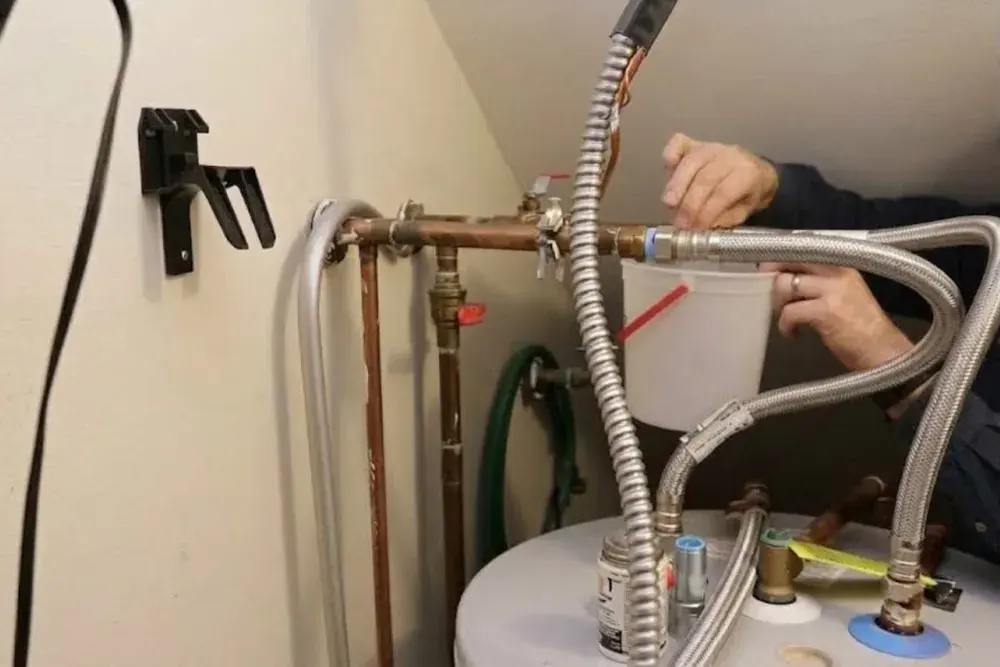
Unscrew the old tank, and thread on a new one with sealant.
Set the air pressure
Match the tank's air pressure to the home's water pressure before restoring service.
Setting the air pressure is the step people miss. A tank charged at the factory setting may not match your home, and a wrong pressure means the tank does not do its job.
Where the Tank Mounts and What Size
A small tank can hang from the cold line above the heater. Larger ones sit on a stand beside it. The size depends on the tank capacity, the water pressure and the temperature rise. A 40 to 50 gallon heater commonly uses a small tank, but check the label.
Installing one is part of a code-compliant water heater job. For a full install, see water heater installation, and if the valve is already dripping, water heater repair.
A Simple Pressure Check at Home
A pressure gauge screws onto an outdoor hose bib or a laundry faucet and costs little. Read it when no water is running, and then again right after the heater has finished a heating cycle. A rise of more than a few pounds points to an expansion problem.
Many homes run between 40 and 80 pounds. Pressure above 80 is hard on fixtures and appliances, and it is worth a visit even if the tank is fine.
What Happens If You Ignore It
Without an effective expansion tank, repeated pressure spikes strain the water heater, the relief valve and the supply connections. Leaks appear at fittings, and relief valves wear out and drip.
Fixing the tank is a small job compared with replacing a heater that failed early, and it is a good question to ask on any water heater visit.
A Checklist for Your Next Water Heater Visit
Ask the plumber to check the water pressure, test the expansion tank and inspect the relief valve and its discharge line. Ask whether the system is closed and whether a pressure reducing valve is installed.
Those four questions take a few minutes and can prevent a leak. If we are on your property for any water heater job, we are glad to check them.
Tank Orientation and Support
Expansion tanks can hang from the pipe or stand on a support. A heavy tank hanging from a copper pipe can stress the connection over time. A bracket or a floor stand solves that.
If you see a tank sagging or a connection weeping, mention it. It is an easy fix before it becomes a leak.
Pressure at the Source
If the pressure is high at your tap, the tank is only treating the symptom. A pressure reducing valve brings the pressure into a normal range and protects every fixture. Ask us to test the pressure on a visit, and we will say whether a valve is needed.
We help homeowners in nearby towns such as Pennsauken and Mount Laurel with the same checks.
Common Questions
Often 5 to 10 years, but it depends on pressure and temperature.
It may be. A failed expansion tank is a common cause of a dripping relief valve.
If your system is closed, code often requires one. A plumber can check.
In New Jersey plumbing work must be done by a licensed professional.
Many tanks installed decades ago predate current practice, so check whether yours has one.